
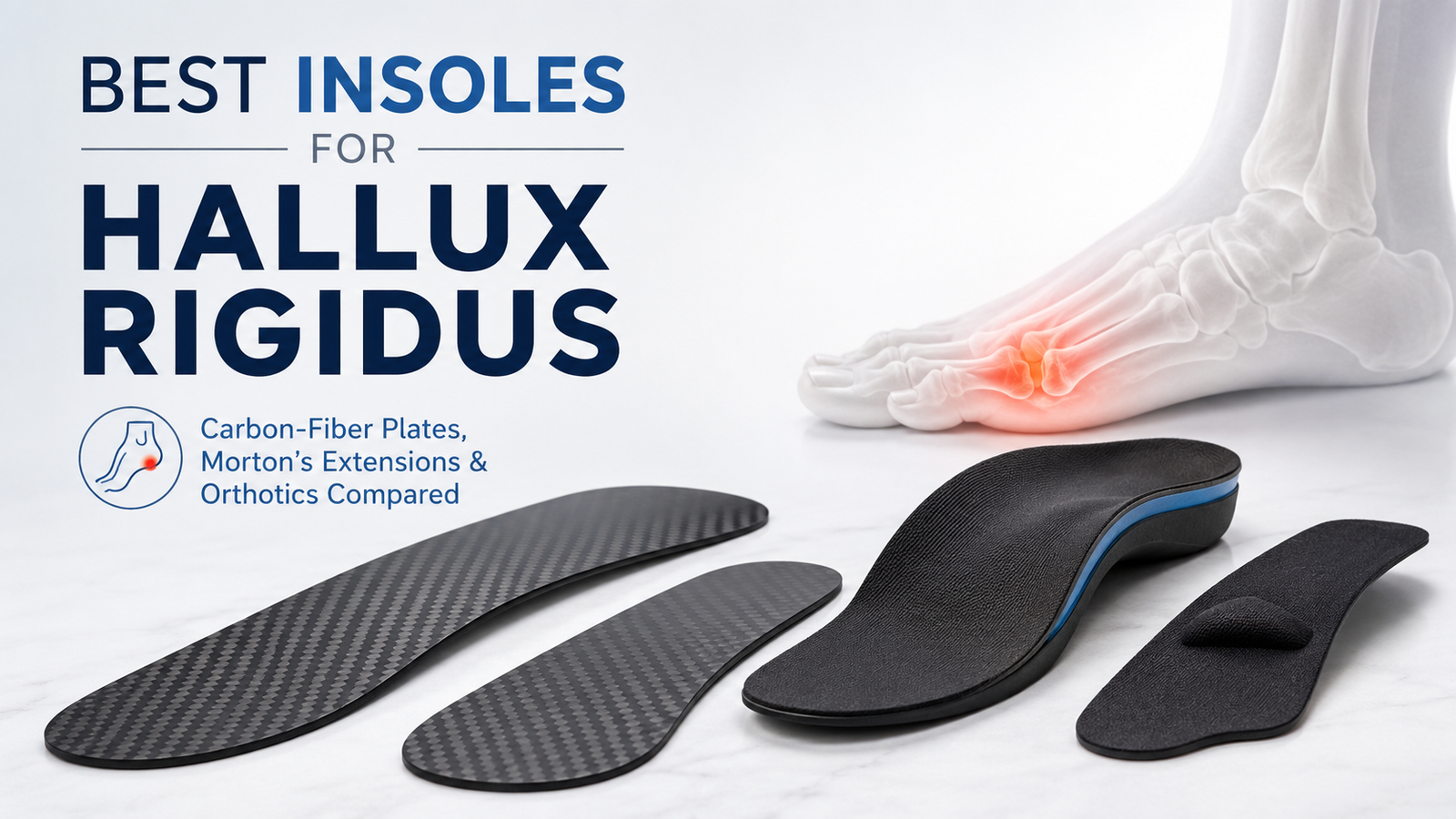
The best insoles for hallux rigidus are not necessarily the softest, thickest, or most heavily cushioned products.
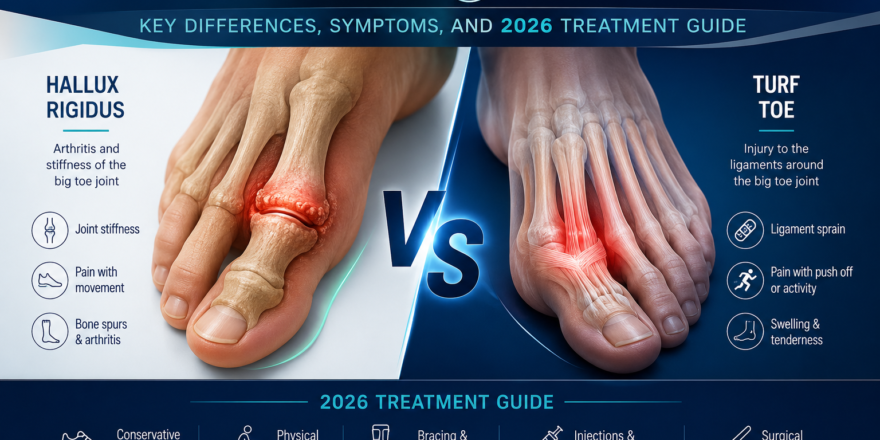
Hallux rigidus is arthritis of the first metatarsophalangeal joint—the joint at the base of the big toe. This joint normally bends upward during the push-off phase of walking. When the joint becomes stiff and painful, reducing that movement may be more useful than adding cushioning alone.
For this reason, many hallux rigidus insoles use a rigid or semi-rigid component, such as:
A Morton’s extension
A full-length carbon-fiber plate
A contoured carbon-fiber orthotic
A supportive insole with an integrated stiffening plate
A professionally prescribed custom orthotic
The American Academy of Orthopaedic Surgeons includes stiff carbon-fiber inserts, Morton’s extensions, stiff-soled shoes, and rocker-bottom footwear among the nonsurgical options that may reduce painful movement through the big-toe joint. These interventions manage symptoms; they do not reverse cartilage loss or remove a bone spur.
This guide explains the main types of insoles for hallux rigidus and compares five full-length carbon-fibre insert options by quantity, stiffness, construction, sizing requirements, footwear compatibility, and intended use.
Medical disclaimer: This article is for general educational purposes and does not replace diagnosis or individualized treatment from a podiatrist, orthopedic clinician, or other qualified healthcare professional.
What Type of Insole Is Best for Hallux Rigidus?
An insole that reduces painful bending at the base of the big toe may be more useful for hallux rigidus than a soft cushioning insert alone.
The most suitable option depends on your symptoms and footwear:
Integrated orthotic: A practical choice when you want cushioning, arch support, and a stiffening plate in one product.
Morton’s extension: Designed to limit movement beneath the first metatarsal and big toe.
Full-length carbon plate: Stiffens a larger portion of the shoe and forefoot.
Contoured carbon orthotic: Combines shape and stiffness but requires sufficient shoe depth.
Custom orthotic: May be appropriate when foot mechanics, asymmetry, skin risk, or persistent pain complicate treatment.
There is no universally best design. An insert is only useful when it fits the shoe correctly, reduces the intended movement, remains comfortable, and does not create pressure elsewhere.
Hallux Rigidus Insole Options at a Glance
| Product | Design category | Quantity | Main advantage | Main limitation |
|---|---|---|---|---|
| MRTHN Carbon-Fibre Insoles | Full-length rigid flat plates | Pair | Matching stiffness for both shoes | No cushioning or arch contour |
| EstCarbon Carbon-Fibre Insole | Full-length rigid reversible plate | One insert | Useful for one-sided symptoms | A second insert is needed for bilateral use |
| ONUJO Carbon-Fibre Insoles | Full-length rigid flat plates | Verify listing | Low-profile pair-style design | Exact Amazon listing and specifications need verification |
| MARRDO Carbon-Fibre Sports Insoles | Full-length rigid sports plates | Pair | Designed for matched use in athletic footwear | Requires careful measurement and sufficient shoe space |
| DOCARBONFI Carbon-Fibre Insoles | Full-length rigid shoe-stiffening plates | Pair | Straightforward low-profile rigid design | No built-in cushioning; exact variant details may vary |
Amazon prices, sellers, sizes, availability, and product specifications can change. Confirm the selected listing and variant before publishing an affiliate link.
How We Selected These Insoles
Hallux Rigidus Care did not physically test these products.
We compared current product listings using factors that are especially relevant when selecting a shoe-stiffening insert for hallux rigidus:
- Full-length versus targeted construction
- Rigid or semi-rigid design
- Carbon-fibre thickness when clearly stated
- Single insert versus pair
- Flat versus contoured construction
- Placement beneath or instead of the original shoe insole
- Sizing and measurement instructions
- Compatibility with removable factory insoles
- Shoe-depth and toe-box requirements
- Seller transparency
- Current listing availability
- Alignment with published evidence about shoe-stiffening inserts
The five options are variations of the same broad product category rather than five completely different medical technologies. Most are flat, rigid carbon-fibre plates designed to increase shoe stiffness.
Medical evidence supports shoe-stiffening inserts as a category for some people with first-MTP-joint osteoarthritis. It does not prove that one of these commercial products is clinically superior to every other option.
Because this is a research-based comparison rather than a hands-on test, the products are evaluated by construction and practical use case rather than being ranked as definitively “best.”
5 Hallux Rigidus Insole Options Compared
1. MRTHN Carbon-Fibre Insole Pair
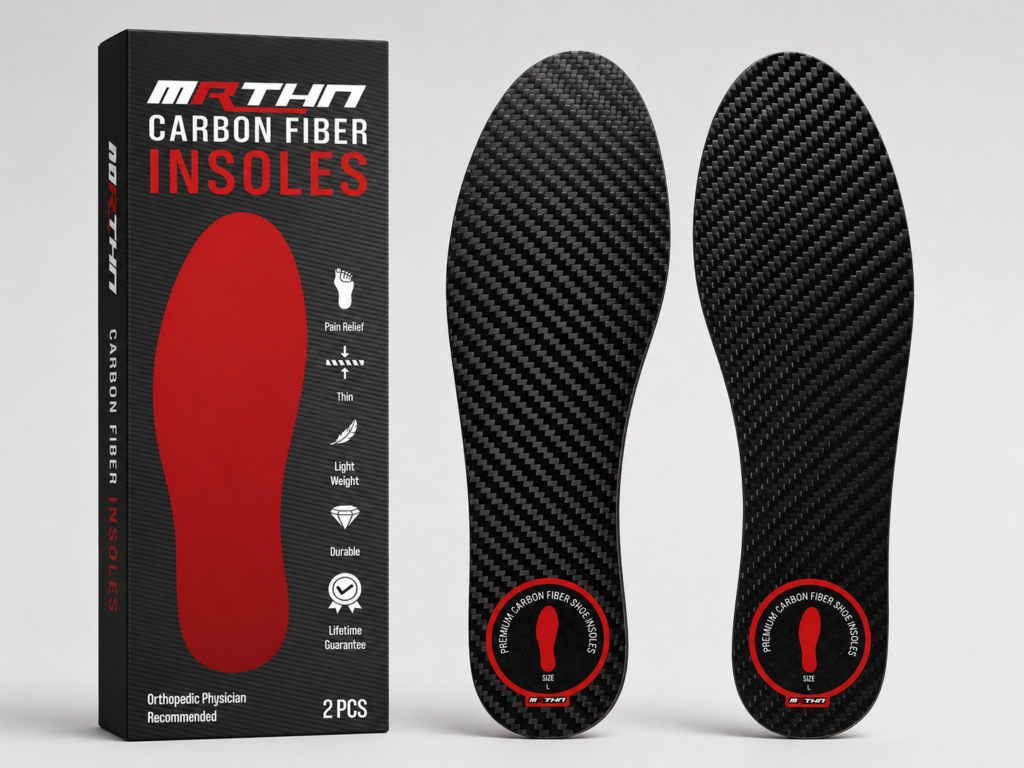
The MRTHN carbon-fibre insoles are full-length, flat plates supplied as a matching pair.
The current Amazon listing describes them as approximately 1.2 mm thick, lightweight, rigid, and designed to reduce flexibility inside the shoe. They are intended to sit beneath the original removable shoe insole rather than function as cushioned replacement orthotics.
Because both inserts are included, they create similar stiffness in the left and right shoes. This may feel more balanced than placing one rigid plate in only one shoe, although using a plate in an unaffected foot is not automatically necessary.
The listing markets the product for hallux rigidus, turf toe, foot fractures, arthritis, and sports use. These are seller claims and should not be interpreted as proof that the insoles treat or cure any condition.
May suit
- People who want equal stiffness in both shoes
- Roomy athletic or walking shoes
- Shoes with removable factory insoles
- Users who do not require additional arch support
- People whose big-toe pain improves in stiff-soled footwear
May not suit
- Shallow or tight-fitting shoes
- People who need cushioning or arch contour
- Users who find rigid forefoot plates uncomfortable
- Dress shoes
- People whose symptoms affect only one foot and who want to avoid restricting the other shoe
Important sizing point
Measure the removable shoe insole rather than relying only on the labelled shoe size.
The plate must lie flat without pressing against the toe of the shoe or raising the foot high enough to create pressure across the big-toe joint.
Editorial assessment
The MRTHN option is most useful as a simple matched pair. Its main strength is symmetry, while its main limitation is that it offers stiffness without cushioning or personalised support.
2. EstCarbon Full-Length Carbon-Fibre Insole
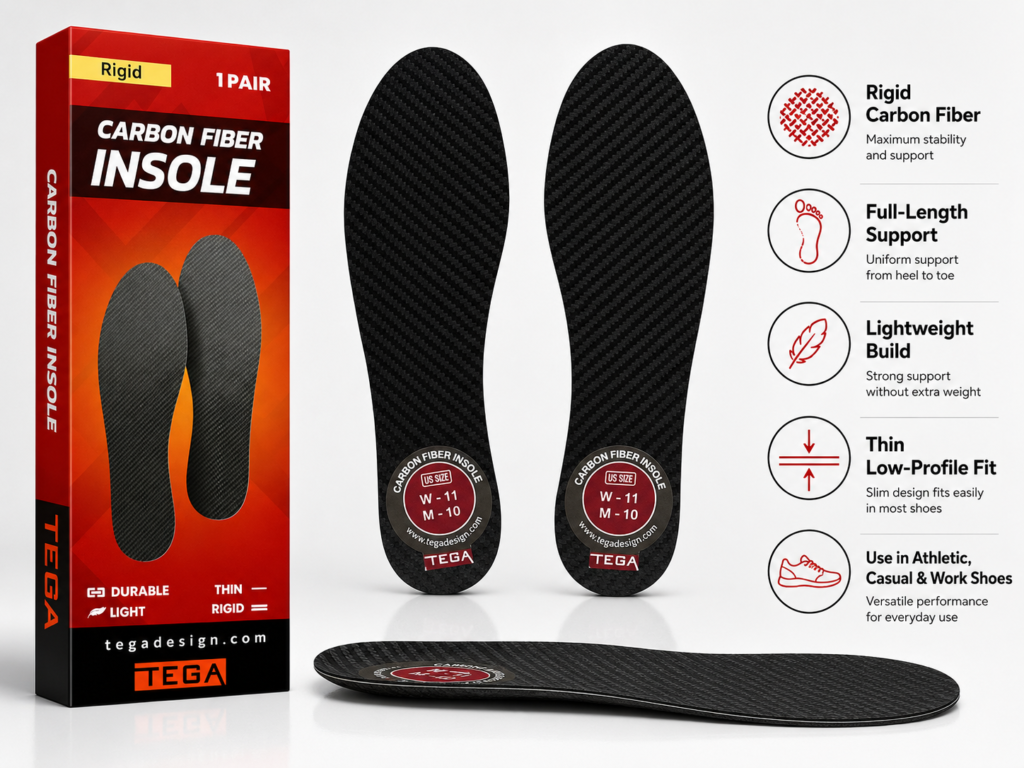
According to the listing, it is approximately 1.2 mm thick, completely flat, made from 3K twill carbon fibre, and reversible so it may be used in either the left or right shoe.
Unlike a complete orthotic, it does not have:
- A cushioned top cover
- A heel cradle
- Built-in arch support
- A contoured footbed
Its primary role is to stiffen the shoe and reduce forefoot movement. The seller recommends wearing it beneath a softer removable insole rather than directly beneath the foot.
May suit
- Unilateral hallux rigidus
- People who need stiffness in only one shoe
- Users who already have a comfortable removable factory insole
- Buyers who prefer a simple, low-profile plate
- People who want a broad range of available lengths
May not suit
- Bilateral symptoms unless two plates are purchased
- People sensitive to left-right differences in shoe stiffness
- Users needing arch support
- Shoes without removable insoles
- Tight or shallow footwear
Important sizing point
The listing advises measuring the foot or shoe carefully and selecting the next smaller size if uncertain.
Because the plate is rigid, it should not bunch, curl, or press against the front of the shoe.
Editorial assessment
EstCarbon is the clearest single-foot option in this group. It may be practical for unilateral symptoms, but using one rigid plate can change the feel of one shoe relative to the other.
3. ONUJO Carbon-Fibre Insole Pair
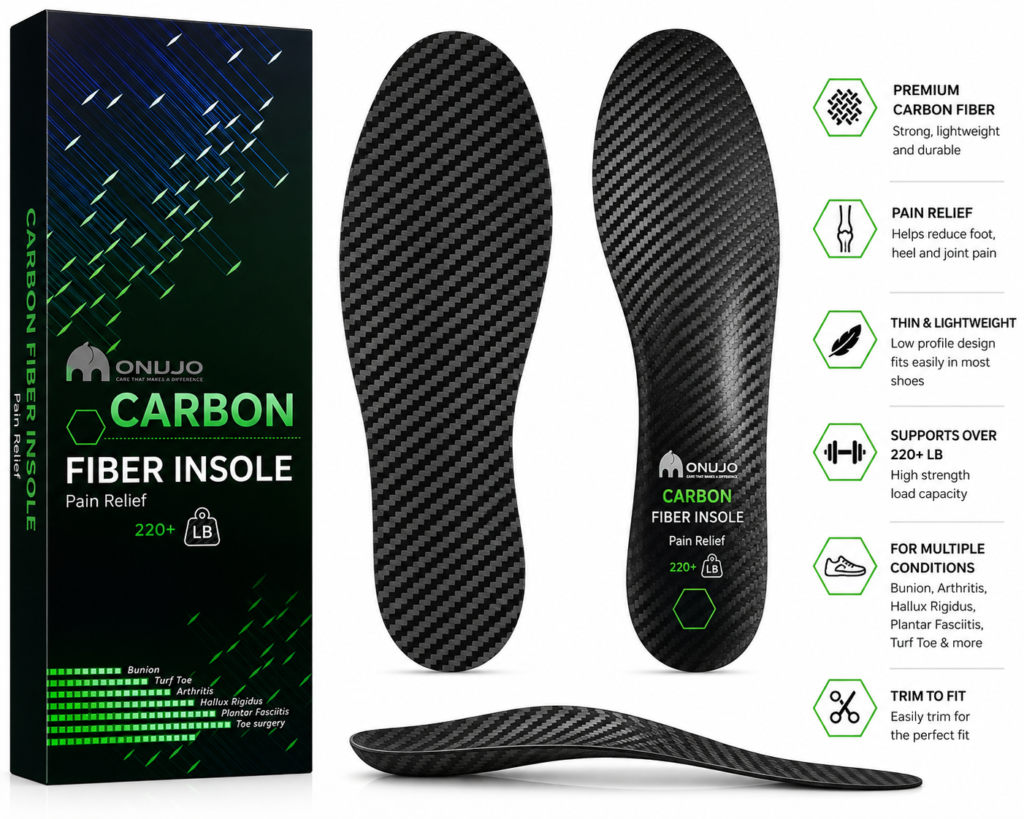
The ONUJO product is presented as a pair of thin, full-length carbon-fibre inserts intended to increase stiffness inside compatible footwear.
Its packaging and available marketplace information associate the inserts with hallux rigidus, hallux limitus, turf toe, arthritis, and recovery use.
However, an exact, consistently accessible Amazon.com product page under the ONUJO brand could not be independently verified during the latest check. A secondary marketplace listing identifies an ONUJO pair, but that is not sufficient to confirm every specification appearing on the packaging or mockup.
Before publishing this section, confirm from the exact Amazon product page:
- Whether one insert or a pair is included
- Exact thickness
- Available lengths
- Whether the inserts are trimmable
- Whether they sit beneath or replace the original insole
- Maximum-load claims
- Seller and return policy
- Current stock
- Correct product name and brand spelling
May suit
- People seeking a low-profile rigid pair
- Athletic or casual shoes with removable insoles
- Users who want matching stiffness in both shoes
- Shoes with enough internal length and depth
May not suit
- Publication as a leading recommendation without a verified link
- Shallow shoes
- Users who need cushioning
- People who require a contoured orthotic
- Anyone relying on packaging claims without checking the live listing
Editorial assessment
Keep ONUJO in the article only after confirming its exact Amazon listing. Until then, describe it as a provisional comparison option rather than a fully verified recommendation.
4. MARRDO Carbon-Fibre Sports Insole Pair
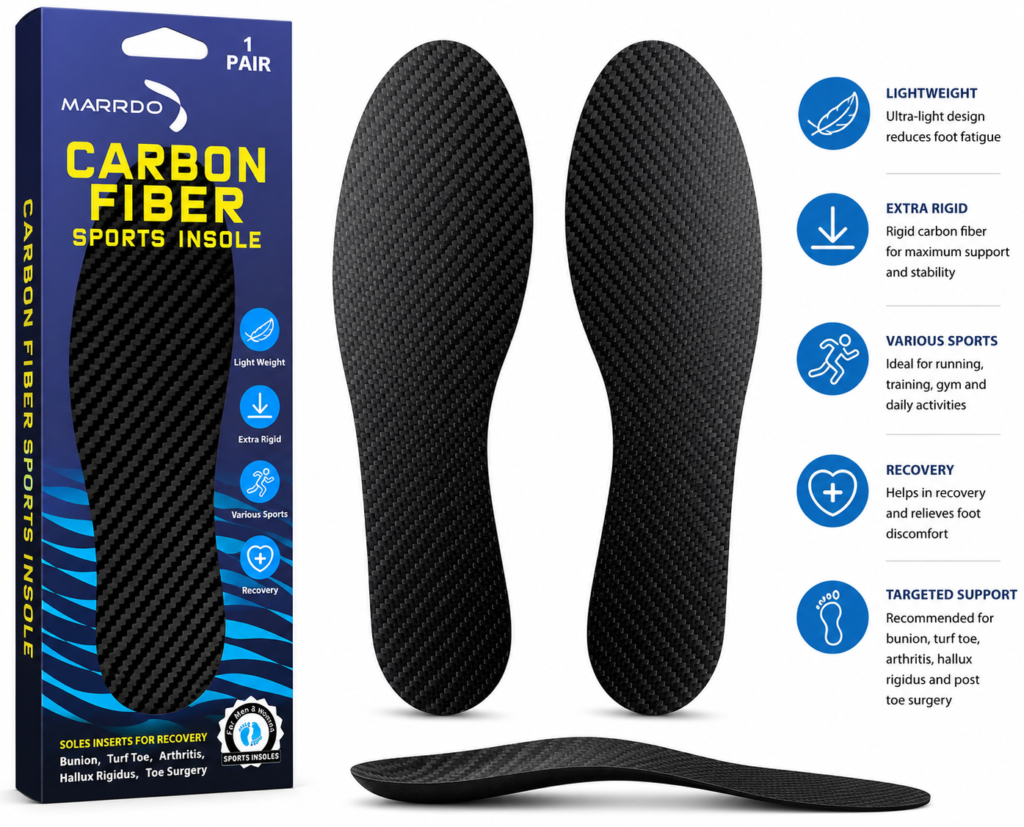
The MARRDO carbon-fibre sports insoles are marketed as full-length rigid plates supplied as a pair for men and women.
Current Amazon results position them for athletic shoes, hiking, running, training, and other activities where greater sole stiffness is desired. Available listings describe rigid carbon-fibre inserts that sit beneath the removable shoe insole.
One current product variant describes:
- A full-length design
- A matching pair
- Rigid carbon-fibre construction
- Approximately 1.2 mm thickness
- Multiple lengths
- Placement beneath the removable shoe insole
- A recommendation to leave space between the plate and the front of the original insole
Seller statements about shock absorption, athletic performance, energy return, injury prevention, or recovery should be treated as marketing claims unless supported by independent product-specific testing.
May suit
- Athletic shoes with removable insoles
- People who want equal stiffness in both shoes
- Hiking or training footwear with sufficient depth
- Users who prefer a thin flat plate
- People whose symptoms improve when the forefoot bends less
May not suit
- Tight sports shoes
- People who want a soft or flexible feel
- Users needing arch correction
- Dress shoes
- Anyone who chooses size solely from the footwear label
Important sizing point
Measure the removable shoe insole and follow the exact seller’s length chart.
A rigid plate that is too long may press against the front of the shoe, while one that is too short may shift or fail to provide the intended stiffening effect.
Editorial assessment
MARRDO is best presented as a sports-oriented matched pair. The construction is similar to several other rigid plates, so the main deciding factors are size availability, seller reliability, shoe compatibility, and price—not a proven clinical performance advantage.
5. DOCARBONFI Carbon-Fibre Insole Pair
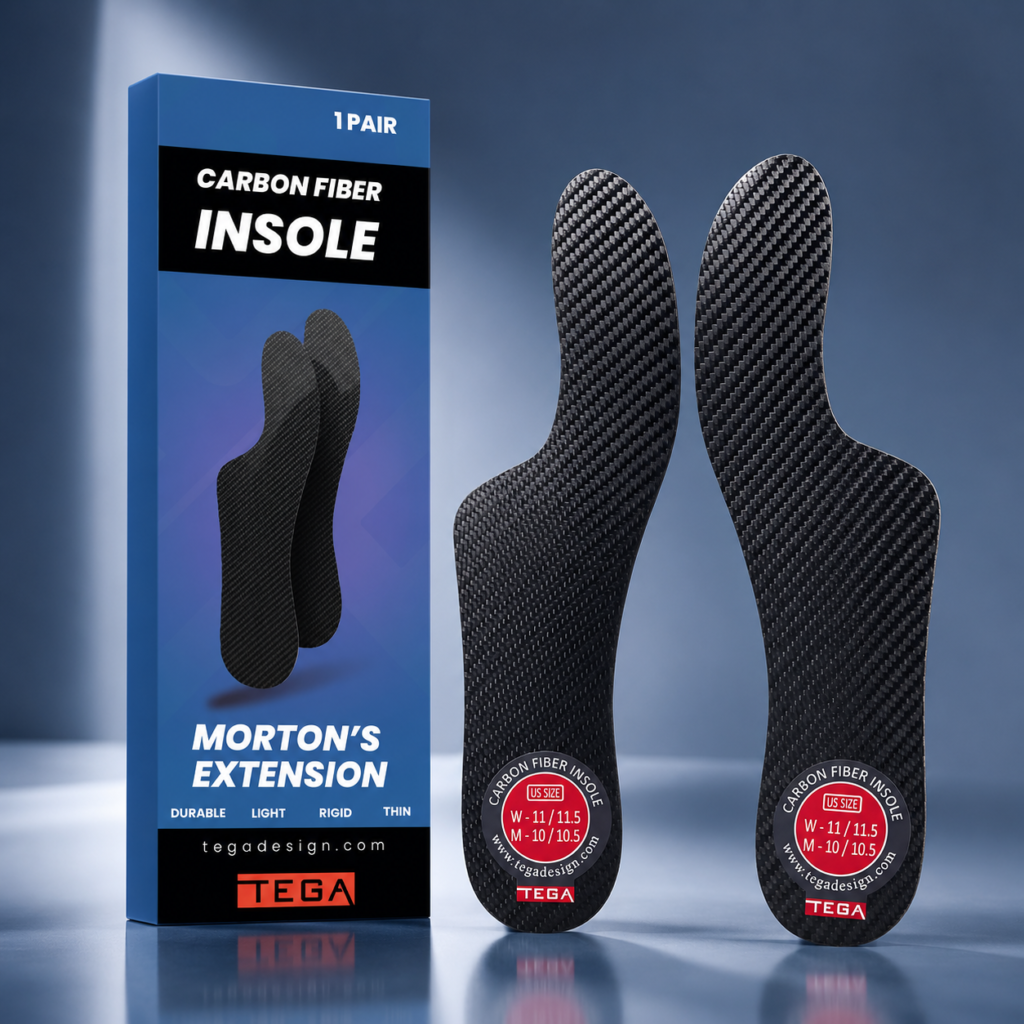
DOCARBONFI offers a full-length rigid carbon-fibre shoe-insert pair marketed for hallux rigidus, hallux limitus, turf toe, arthritis, foot fractures, and related conditions.
A current Amazon product page identifies the product as a pair of rigid shoe inserts, although the page could not be fully retrieved during the most recent check.
The product mockup presents a thin, flat construction rather than a cushioned or arch-contoured orthotic.
Before publishing, verify:
- Exact thickness
- Whether the package contains one insert or a pair for the selected variant
- Available lengths
- Whether it is reversible
- Whether it is safe to trim
- Placement instructions
- Warranty terms
- Seller details
- Current return policy
Do not repeat packaging statements such as “physician recommended,” “pain relief,” or “two-year warranty” as independent facts unless the live listing provides verifiable support.
May suit
- Users who want a basic full-length rigid plate
- Shoes with removable cushioning layers
- People who want similar stiffness in both shoes
- Athletic, casual, or work shoes with sufficient internal volume
May not suit
- Buyers who need fully verified specifications before ordering
- Shallow shoes
- People requiring arch support
- Users who find rigid plates uncomfortable
- Anyone expecting a cushioned replacement orthotic
Editorial assessment
DOCARBONFI may be included as a basic paired carbon-plate option, but its exact listing details should be reconfirmed immediately before publication.
Can Insoles Help Hallux Rigidus?
Insoles may help hallux rigidus when they reduce painful movement at the first MTP joint or change how the foot moves through push-off.
A randomized trial of people with first MTP joint osteoarthritis found that shoe-stiffening inserts produced greater pain improvement than sham inserts over 12 weeks. This supports shoe stiffening as a treatment category, but it does not prove that every commercial carbon-fiber plate performs equally well.
A separate small randomized trial compared flexible carbon-fiber insoles with traditional rigid Morton’s extensions. Participants using flexible carbon-fiber insoles reported better comfort, higher adherence, and improved pain outcomes at several follow-up points. The trial included only 13 participants, so its findings should be treated as preliminary rather than definitive.
Current evidence therefore suggests:
Shoe-stiffening inserts may help some people.
A completely rigid design is not automatically superior.
Comfort and regular wear matter.
Product fit and shoe compatibility influence the outcome.
More high-quality research is still needed.
What Is a Morton’s Extension?
A traditional Morton’s extension is a rigid section of an orthotic that extends beneath the first metatarsal and big toe.
Its purpose is to reduce upward movement at the first MTP joint during walking.
The term is used inconsistently in online product listings. Products called “Morton’s extensions” may include:
A targeted rigid extension under the big toe
A flat full-length carbon plate
A cushioned orthotic with an integrated carbon component
A single reversible plate
A pair of full-length rigid inserts
This is why buyers should examine the product’s actual shape and construction rather than relying on the title alone.
Morton’s extension is not the same as reverse Morton’s extension
A standard Morton’s extension supports or stiffens the region beneath the first ray and big toe.
A reverse Morton’s extension is a different modification that generally creates space or support beneath the lesser metatarsals while leaving the first ray relatively unloaded.
The two terms should not be used interchangeably.
Morton’s Extension vs. Full-Length Carbon Plate
| Feature | Traditional Morton’s extension | Full-length carbon plate |
|---|---|---|
| Primary area affected | First ray and big toe | Larger portion of the shoe |
| Main goal | Limit first MTP joint movement | Increase overall shoe stiffness |
| Typical construction | Targeted extension or built-in orthotic component | Flat heel-to-toe or near-full-length plate |
| Cushioning | Depends on the orthotic | Usually none |
| Arch support | May be included in a complete orthotic | Usually absent |
| Shoe-space requirement | Moderate | Depends on plate thickness and shoe length |
| Common concern | May feel overly rigid beneath the first ray | May alter the feel of the whole shoe |
Neither design is automatically better.
A targeted extension may provide more localized motion control, while a full-length plate may create a more uniform stiffening effect.
Rigid vs. Semi-Rigid Insoles for Hallux Rigidus
A rigid insert may be more suitable when:
Big-toe bending consistently reproduces pain
A very stiff shoe already feels better
A clinician recommends strong motion restriction
The user tolerates limited forefoot flexibility
The shoe has enough room
A semi-rigid insert may be worth considering when:
Fully rigid plates feel uncomfortable
Some big-toe movement remains tolerable
The user struggles to wear a rigid plate consistently
A gradual change in stiffness is preferred
Comfort and adherence are the main barriers
Terms such as “rigid,” “semi-rigid,” and “flexible” are not standardized across Amazon sellers.
Thickness alone also does not determine stiffness. Plate width, shape, carbon-fiber orientation, layering, and curvature can affect how much the insert bends.
Are Soft Cushioned Insoles Enough?
A soft insole may improve general underfoot comfort, but cushioning alone may not meaningfully reduce movement at the big-toe joint.
This distinction matters because hallux rigidus pain is often connected to joint motion during push-off.
A cushioned insole may still be useful when:
It contains an integrated stiffening component
It is used above a separate carbon plate
It improves shoe fit without squeezing the toe
It addresses another source of discomfort
It remains stable inside the shoe
Avoid assuming that more cushioning automatically means better hallux rigidus control.
OTC vs. Custom Orthotics for Hallux Rigidus
An over-the-counter insert is ready-made and sold in standard sizes.
A custom orthotic is created following an individual assessment and may include modifications such as:
A Morton’s extension
A first-ray accommodation
A specific arch contour
Heel correction
Metatarsal modifications
Posting or wedging
Pressure-relief areas
Different left and right designs
A custom device may be more appropriate when:
Symptoms persist despite suitable OTC inserts
The feet are significantly different
A flat plate creates new pressure
Foot mechanics contribute to symptoms
Other joints or conditions affect gait
The person has diabetes, neuropathy, circulation problems, or skin risk
There is a history of foot surgery
The diagnosis is uncertain
Custom does not automatically mean better for every person. The quality of the assessment, design, footwear, and follow-up all matter.
How to Choose the Correct Hallux Rigidus Insole
1. Confirm the Cause of the Pain
Not every painful big-toe joint is hallux rigidus.
Other possible causes include:
Gout
Turf toe
Sesamoiditis
A fracture
A bunion
Inflammatory arthritis
Joint infection
Nerve irritation
Post-traumatic arthritis
Seek medical assessment for a first episode of severe, hot, red, rapidly swollen, or unexplained big-toe pain.
2. Decide Whether You Need One Insert or a Pair
A single insert may make sense when only one foot is affected.
A pair may provide:
Equal shoe stiffness
Better left-right symmetry
A more consistent walking feel
The option to use both shoes similarly
However, restricting an unaffected foot unnecessarily may not be desirable.
3. Measure the Removable Shoe Insole
Do not select a rigid plate using shoe size alone.
Remove the factory insole and measure its full length.
Many carbon-plate manufacturers recommend selecting a plate approximately one-quarter to one-half inch shorter than the removable insole. Follow the instructions for the specific product rather than applying one rule universally.
4. Check Shoe Depth
A thick or contoured orthotic takes up more space than a bare carbon plate.
After inserting the device, check that:
The toes are not compressed
The upper does not press on a bone spur
The heel remains secure
The foot does not sit too high
The laces can close comfortably
The shoe does not feel short
5. Check the Shoe’s Existing Sole
An insole cannot correct every unsuitable shoe.
A well-fitting shoe should generally provide:
Adequate toe-box width and depth
A stable heel
Secure fastening
Enough internal room
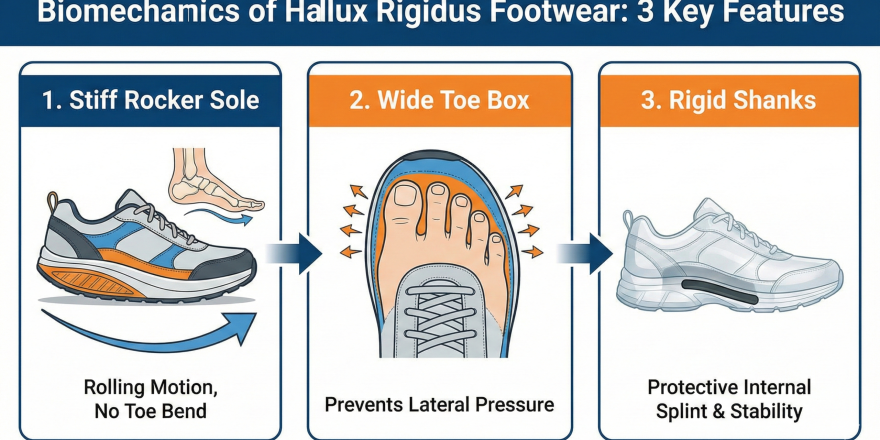
A firm or appropriately rocker-shaped sole
No painful seam over the big-toe joint
Read our guide to the best shoes for hallux rigidus before combining an insert with footwear.
6. Do Not Cut Carbon Fiber Unless Explicitly Allowed
Rigid carbon-fiber plates are not the same as foam trim-to-fit insoles.
Cutting them may:
Damage the structure
Create sharp edges
Release carbon-fiber dust
Cause cracking
Void the product’s instructions
Choose the correct size instead.
7. Introduce the Insert Gradually
Begin with shorter periods of wear.
Monitor:
Big-toe pain
Arch pressure
Heel comfort
Skin redness
New pain under the lesser toes
Balance
Knee, hip, or back discomfort
Symptoms the following morning
Stop using the device and seek advice if it causes sharp pain, numbness, skin damage, instability, or progressively worsening symptoms.
Can Insoles Make Hallux Rigidus Pain Worse?
Yes, an unsuitable insert can increase discomfort.
Possible reasons include:
The plate is too long
The insert shifts inside the shoe
The toe box becomes too shallow
The arch contour does not match the foot
The device is too rigid
A hard edge creates pressure
The footwear is already too tight
The insert changes gait uncomfortably
Only one shoe becomes substantially higher or stiffer
The original diagnosis is incorrect
More rigidity is not always better. A device that blocks toe movement but cannot be worn comfortably is unlikely to provide lasting value.
What Shoes Work Best With Hallux Rigidus Insoles?
The most compatible shoes usually have:
A removable factory insole
Adequate internal depth
A roomy toe box
Secure lacing
A stable heel counter
Sufficient length for the plate
A firm or moderately stiff sole
No upper pressure over the big-toe joint
Sneakers, walking shoes, hiking shoes, and some work shoes are generally easier to fit than shallow dress shoes.
Some people may prefer a purpose-built rocker-bottom shoe for hallux rigidus instead of adding a rigid plate to a flexible shoe.
Can Insoles Help Advanced Hallux Rigidus?
An insert may still reduce painful movement in advanced hallux rigidus, but results can be less predictable when:
The joint has very little motion
Pain occurs at rest
Large bone spurs cause shoe pressure
Walking remains painful in stiff footwear
Symptoms repeatedly interrupt daily life
Pain continues despite several appropriate nonsurgical measures
Insoles cannot restore cartilage or remove an osteophyte.
Persistent or worsening symptoms may require a review of:
The diagnosis
Arthritis severity
Footwear
Medication
Injection options
Activity modification
Surgical treatment
Read our hallux rigidus flare-up guide if your symptoms have recently become worse.
Final Verdict
Frequently Asked Questions
What type of insole is best for hallux rigidus?
An insert that limits painful big-toe movement may be more helpful than a soft cushioning insole alone.
Potential options include a Morton’s extension, full-length carbon-fiber plate, semi-rigid insert, integrated orthotic, or custom device.
Are carbon-fiber insoles good for hallux rigidus?
Carbon-fiber insoles may help by increasing shoe stiffness and reducing movement through the first MTP joint.
Clinical evidence supports shoe-stiffening inserts as a category, but individual products and patient responses vary.
Is a Morton’s extension better than a full-length carbon plate?
Not necessarily.
A Morton’s extension provides more targeted support beneath the first ray and big toe. A full-length plate stiffens a larger portion of the shoe.
The better option depends on comfort, footwear, symptoms, and the amount of motion that needs to be restricted.
Should I choose a rigid or semi-rigid insole?
A rigid plate limits more movement.
A semi-rigid option may be easier to tolerate and wear regularly. A small trial suggested flexible carbon-fiber insoles may offer better comfort and adherence than traditional rigid Morton’s extensions, but larger studies are needed.
Do I remove the original shoe insole?
A full replacement orthotic normally replaces the factory insole.
A thin carbon plate is commonly placed underneath the original removable insole. Follow the instructions for the specific product.
Can I use a carbon plate in only one shoe?
Yes, but it may create a difference in stiffness or height between the shoes.
Monitor your walking comfort and consider professional advice if the asymmetry causes new symptoms.
Can a carbon plate be used in dress shoes?
Many dress shoes do not have enough internal depth or width.
Rigid plates generally work better in shoes with removable insoles and sufficient toe-box space.
Are custom orthotics worth the cost?
They may be worthwhile when symptoms or foot mechanics are complex, OTC products have failed, the feet differ significantly, or medical conditions increase the risk of pressure and skin injury.
They are not automatically necessary for everyone.
How long does it take to adjust to an insole?
There is no universal adjustment period.
Begin with short wear periods and increase use only if the device remains comfortable. New or worsening pain is a reason to reassess the fit.
Medical References
American Academy of Orthopaedic Surgeons. Hallux Rigidus: Stiff Big Toe.
Munteanu SE, Landorf KB, McClelland JA, et al. Shoe-Stiffening Inserts for First Metatarsophalangeal Joint Osteoarthritis: A Randomised Trial. 2021.
Bhimani R, et al. Use of Flexible Carbon Fiber Insoles for Hallux Rigidus: A Randomized Controlled Trial. 2022.
Colò G, et al. The Efficacy of Shoe Modifications and Foot Orthoses in Treating Patients With Hallux Rigidus.
Acker AS, Mendes de Carvalho KA, Hanselman AE. Hallux Rigidus: Update on Conservative Management. 2024.
Munteanu SE, et al. Non-Surgical Interventions for Treating Osteoarthritis of the Big Toe Joint. 2024.