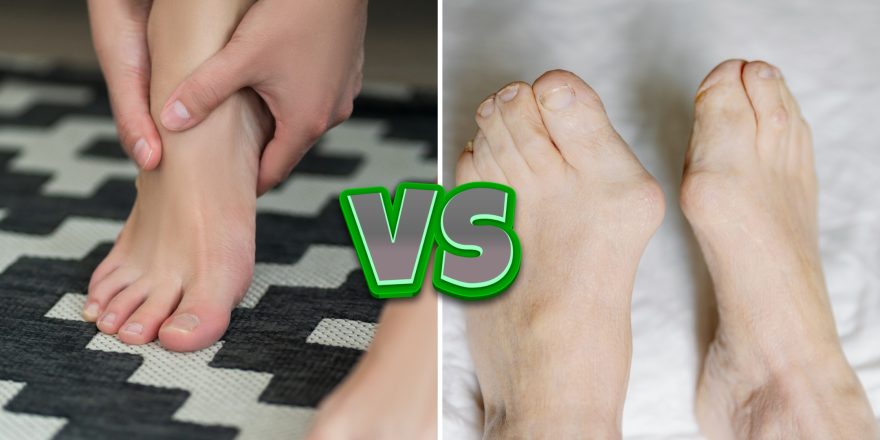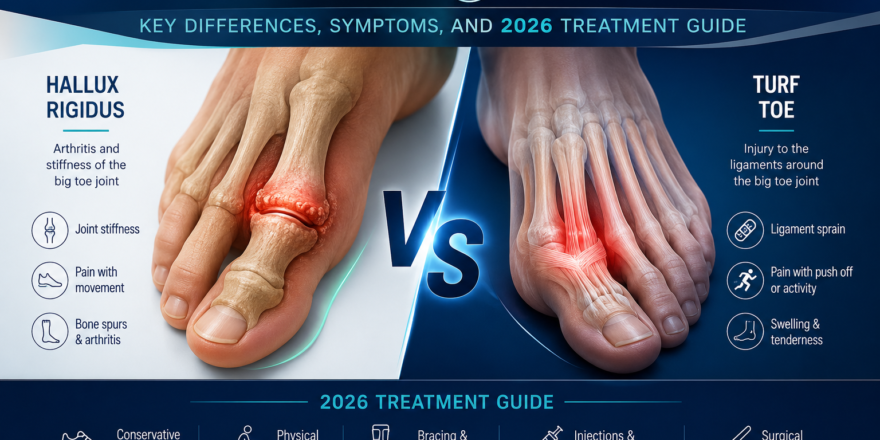

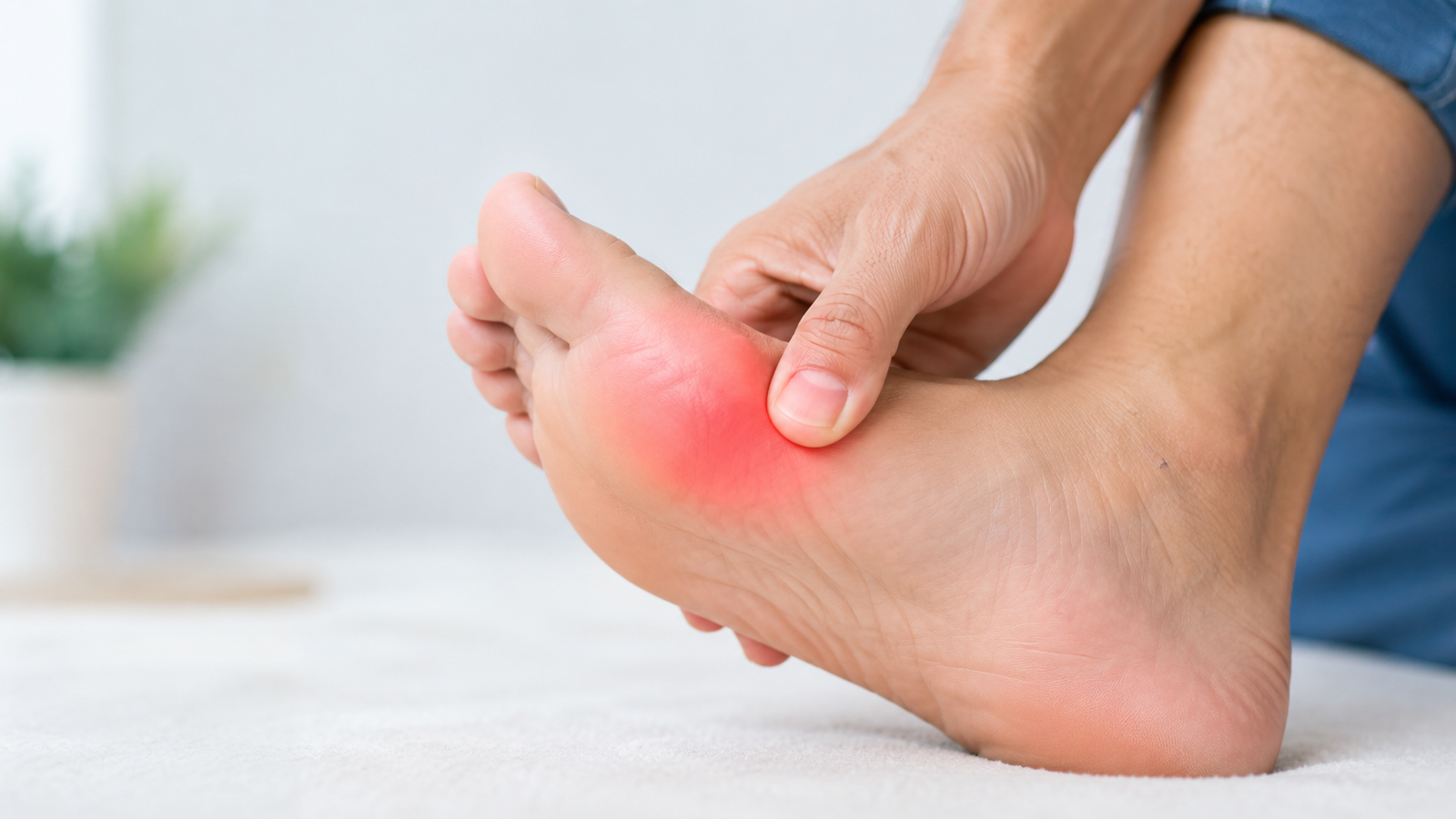
A hallux rigidus flare-up can turn manageable big-toe stiffness into increased pain, swelling, and difficulty walking. It may begin after a long walk, a new exercise routine, a change in footwear, or an activity that repeatedly bends the painful joint.
Hallux rigidus is a form of degenerative arthritis affecting the joint at the base of the big toe. Symptoms can vary from day to day, so a temporary increase in pain does not necessarily mean that the joint has suddenly sustained more structural damage.
However, sudden big-toe pain is not always caused by hallux rigidus. Gout, an acute injury, inflammatory arthritis, and joint infection can affect the same area. A first episode of severe pain—especially when the joint is very red, hot, or swollen—should be medically assessed rather than self-diagnosed.
This guide explains what may cause a hallux rigidus flare-up, how long symptoms can last, how to reduce pain safely, what to avoid, and when to see a healthcare professional.
Medical disclaimer: This article is for general educational purposes and does not replace diagnosis or personalized advice from a qualified healthcare professional.
What Should You Do During a Hallux Rigidus Flare-Up?
When hallux rigidus pain suddenly becomes worse:
- Reduce activities that reproduce sharp pain.
- Avoid repeatedly forcing the big toe upward.
- Wear roomy footwear with a firm or rocker-shaped sole.
- Use a wrapped cold pack for temporary symptom relief.
- Ask a pharmacist or clinician whether pain medication is safe for you.
- Resume normal activity gradually as symptoms improve.
- Seek medical care if the joint is unusually red, hot, severely swollen, injured, or difficult to bear weight on.
These measures cannot reverse the underlying arthritis, but they may reduce temporary joint irritation and make movement more comfortable. The American Academy of Orthopaedic Surgeons includes ice, suitable footwear, stiff or rocker soles, shoe inserts, and selected medications among the nonsurgical measures used for hallux rigidus symptoms. (AAOS: Hallux Rigidus)
What Is a Hallux Rigidus Flare-Up?
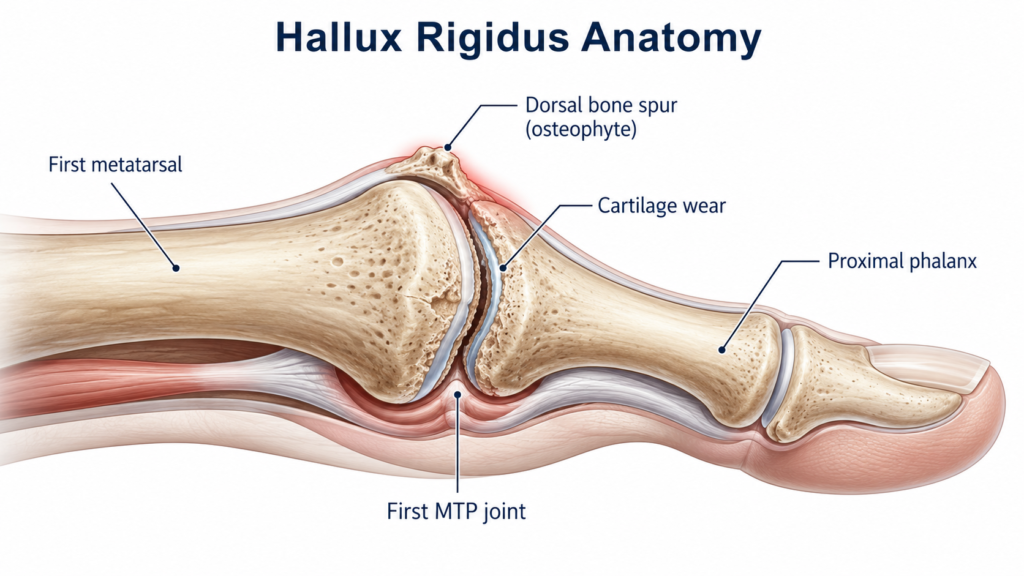
Hallux rigidus affects the first metatarsophalangeal joint, also called the first MTP joint. This is the joint where the big toe meets the foot.
Degenerative changes within the joint can cause:
- Pain during walking or standing
- Reduced upward movement of the big toe
- Stiffness
- Swelling around the joint
- A bone spur on top of the joint
- Difficulty fitting into certain shoes
- Pain during running, squatting, or climbing stairs
A hallux rigidus flare-up is a practical description of a temporary increase in these symptoms. It is not a separate diagnosis or an official disease stage.
During a flare, the joint may feel more painful, tender, swollen, or stiff than usual. Walking tolerance may decrease, and shoes that normally feel comfortable may begin pressing against the joint.
Hallux rigidus is a degenerative arthritic condition, but pain intensity does not always correspond directly to the amount of cartilage loss visible on an X-ray. A temporary increase in symptoms can occur when the joint is irritated or loaded beyond its current tolerance.
Hallux Rigidus Flare-Up Symptoms
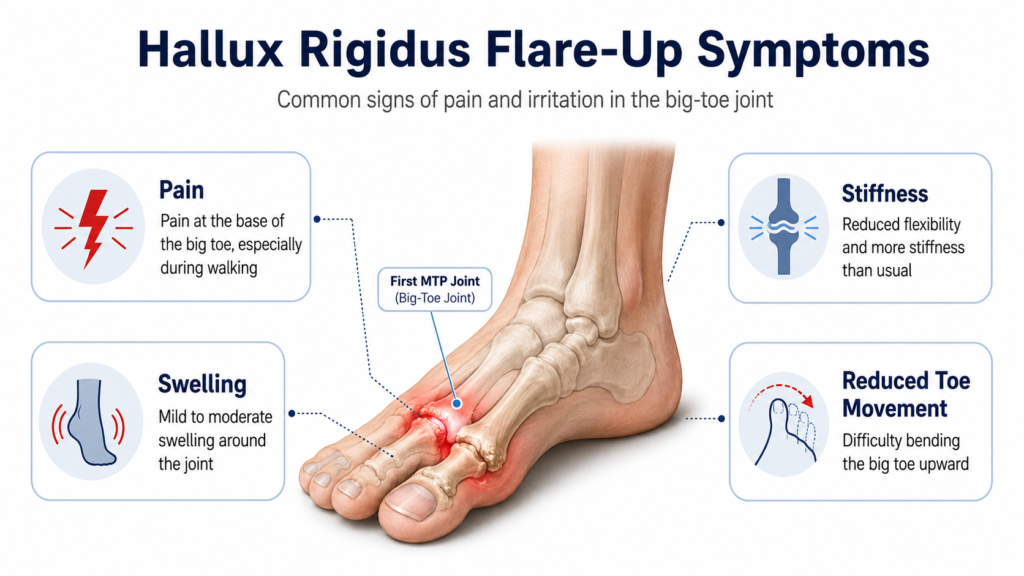
A flare-up may cause one or more of the following:
- Increased pain at the base of the big toe
- Pain on top of the joint
- More stiffness than usual
- Swelling or tenderness
- Pain when pushing off during walking
- Reduced tolerance for standing or walking
- Pain when the toe bends upward
- Pressure from shoes over a bone spur
- Limping or shifting weight toward the outside of the foot
- Aching after activity
- Pain at rest in more advanced cases
Hallux rigidus commonly causes pain and stiffness with walking, standing, bending, running, and squatting. Swelling and difficulty wearing shoes can also occur, particularly when a bone spur has developed on top of the joint. (American College of Foot and Ankle Surgeons)
What Causes Hallux Rigidus to Flare Up?
A flare-up often follows a change in the amount or type of stress placed on the big-toe joint. Sometimes, however, there is no obvious trigger.
A Sudden Increase in Walking or Standing
Long walks, travel, hiking, shopping, sightseeing, or extended periods of standing can repeatedly load the first MTP joint.
A distance that is normally manageable may become aggravating when it is increased suddenly or performed on several consecutive days.
The issue is not necessarily walking itself. It is often the difference between the joint’s current tolerance and the amount of activity placed on it.
Running, Jumping, and Repetitive Push-Off
Running, jumping, lunging, climbing stairs, and similar activities repeatedly require the body to move over the big-toe joint.
When upward movement of the toe is already restricted, repetitive push-off may produce pain at the available end range. Running and squatting are among the activities commonly reported as difficult by people with hallux rigidus.
Flexible or Unsuitable Footwear
Thin or highly flexible footwear allows more movement through the forefoot and big-toe joint. This can aggravate symptoms in some people.
Shoes may also increase discomfort when they:
- Squeeze the forefoot
- Have a shallow toe box
- Press directly on a dorsal bone spur
- Allow the heel to move excessively
- Place the toe in a painful position
- Have a forefoot that bends easily beneath the MTP joint
High heels can shift pressure toward the forefoot and are generally not recommended for hallux rigidus. Firm soles, rocker-shaped soles, and roomy toe boxes may reduce painful motion and direct pressure.
Our guide to the best shoes for hallux rigidus explains how to assess forefoot stiffness, toe-box space, fit, and rocker geometry.
Barefoot Walking on Hard Surfaces
Barefoot walking is not automatically damaging for everyone with hallux rigidus. However, some people experience more pain without a shoe or insert to limit movement through the big toe.
If walking barefoot on tile, concrete, or hardwood floors worsens symptoms, supportive indoor footwear may be more comfortable during a flare.
A New or Unfamiliar Activity
Gardening, home renovation, yoga, sports, or work that involves crouching may load the joint in an unfamiliar way.
Activities that repeatedly force the big toe upward may be particularly uncomfortable. The American College of Foot and Ankle Surgeons recognizes overuse, repetitive stress, stooping, and squatting as possible contributors to hallux rigidus symptoms and development.
Direct Injury
Stubbing, jamming, twisting, or forcefully bending the toe may irritate an arthritic joint. Previous injury is also a recognized risk factor for hallux rigidus.
Pain that begins after a clear injury should not automatically be treated as an ordinary flare-up. A fracture, sprain, turf-toe injury, or other joint damage may require examination or imaging.
Learn more about injury, foot structure, overuse, and other hallux rigidus risk factors.
Pressure Over a Bone Spur
A dorsal osteophyte is a bone spur that can form on top of the big-toe joint. Shoe pressure against this prominence can cause localized tenderness, redness, or skin irritation.
A deeper toe box or carefully positioned padding may reduce contact, but broken skin, an open wound, or signs of infection require professional evaluation.
Cold or Damp Conditions
Some people report that their stiffness and pain become worse in cold or damp weather. This pattern is acknowledged in clinical patient guidance, but individual responses differ and weather may not be the main cause of an episode.
Hallux Rigidus Triggers and Practical Responses
| Possible trigger | Why symptoms may increase | Practical response |
|---|---|---|
| Sudden increase in walking | Repeated loading may exceed current joint tolerance | Temporarily reduce distance and return gradually |
| Long periods of standing | Sustained forefoot loading may aggravate the joint | Take seated breaks and change position regularly |
| Flexible shoes | More movement may occur through the painful MTP joint | Try a firmer, well-fitting shoe |
| Tight or shallow toe box | Direct pressure may irritate swelling or a bone spur | Choose more width and vertical toe-box space |
| Running or jumping | Repeated push-off loads and bends the big toe | Pause painful impact activity temporarily |
| Barefoot walking | The toe may bend without footwear support | Use supportive indoor footwear when helpful |
| New exercise or work task | Unfamiliar motion may irritate the joint | Modify the movement and rebuild tolerance slowly |
| Direct injury | A sprain, fracture, or other injury may be present | Seek assessment when pain follows trauma |
This table is a management aid, not a diagnostic tool. Individual triggers and responses vary.
How Long Does a Hallux Rigidus Flare-Up Last?
There is no medically established recovery time that applies to every hallux rigidus flare-up.
A mild episode associated with temporary overactivity may begin improving within several days after the aggravating activity is reduced. More persistent episodes can take several weeks to settle, especially when the joint continues to be loaded or when the underlying arthritis is more advanced.
Recovery time may be affected by:
- The severity of the underlying arthritis
- The cause of the flare
- Whether painful activity continues
- Footwear and insert selection
- A recent injury
- The presence of a prominent bone spur
- Other medical conditions
- Whether the pain is actually caused by hallux rigidus
The best indicator is usually the direction of the symptoms, not a rigid deadline. Pain, swelling, and walking tolerance should gradually improve.
Arrange an assessment if symptoms:
- Continue worsening
- Remain severe
- Recur frequently
- Change from their usual pattern
- Do not show meaningful improvement
- Begin affecting sleep or normal daily activity
A 2024 review concluded that shoe modifications and insoles are widely recommended for hallux rigidus, but the evidence is still not strong enough to predict exactly who will respond or how quickly. (2024 review: Hallux Rigidus—Update on Conservative Management)
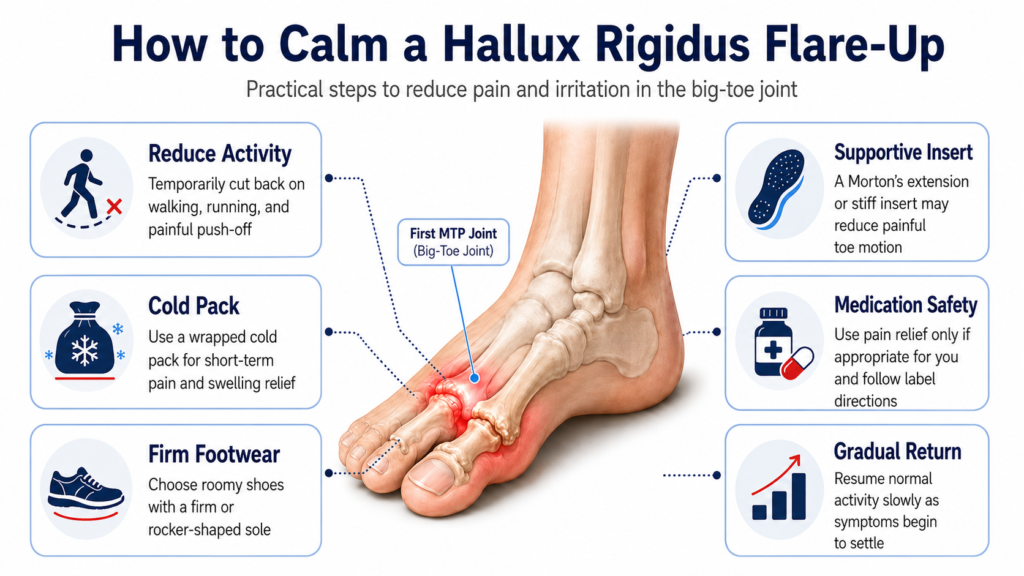
How to Calm a Hallux Rigidus Flare-Up
1. Reduce the Activity That Is Aggravating the Joint
Temporarily reduce movements that reproduce sharp or increasing pain, such as:
- Long walks
- Running
- Jumping
- Repeated stair climbing
- Deep lunges
- Prolonged standing
- Barefoot walking when painful
- Kneeling with the toe forced upward
This is often called relative rest. It means reducing the activity that is aggravating the joint rather than remaining completely inactive for an unnecessarily long period.
Steps to calm a hallux rigidus flare-up with reduced activity, cold therapy, firm footwear and gradual return
2. Use a Wrapped Cold Pack
A cold pack may temporarily reduce pain and swelling.
Wrap the pack or a bag of frozen vegetables in a cloth before placing it over the joint. Do not put ice directly on the skin.
Stop if the treatment causes burning, worsening pain, prolonged numbness, or skin irritation. People with poor circulation, neuropathy, or reduced sensation should ask a healthcare professional whether cold therapy is appropriate.
AAOS recommends wrapping ice rather than applying it directly and describes it as a temporary method for controlling symptoms.
3. Wear a Firm, Roomy Shoe
During a flare, look for footwear that:
- Has enough width for the forefoot
- Has sufficient depth above the big-toe joint
- Does not press on a bone spur
- Resists excessive bending beneath the forefoot
- Holds the heel securely
- Feels stable during walking
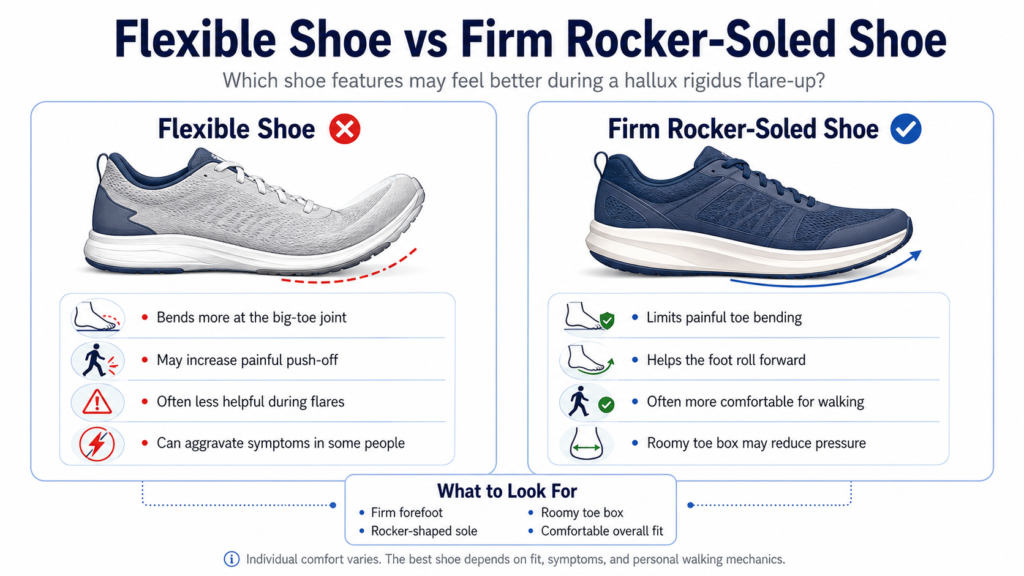
A rocker-shaped sole may help the body roll forward while reducing the amount of movement required at the first MTP joint. A firm forefoot can serve a related purpose by limiting painful bending.
Readers needing this type of footwear can compare our guide to rocker-bottom shoes for hallux rigidus.
4. Consider a Shoe-Stiffening Insert or Orthotic
A Morton’s extension, carbon-fibre plate, prefabricated orthosis, or other insert may reduce painful motion or alter pressure around the first MTP joint.
No single insert is best for every person. Results depend on:
- The location of the pain
- Foot structure
- Shoe design
- The severity of stiffness
- Balance and walking pattern
- Whether the device fits comfortably
A randomized trial found that carbon-fibre shoe-stiffening inserts reduced pain more than sham inserts over 12 weeks. Another trial found that both prefabricated orthoses and rocker-sole footwear improved pain, although orthoses had better adherence and fewer reported adverse events in that study. (Shoe-stiffening insert trial; orthoses versus rocker-sole trial)
These findings show that the interventions may help; they do not guarantee pain relief.
Our hallux rigidus insoles and orthotics guide explains the practical differences between common insert types.
5. Consider Medication Safely
Oral or topical nonsteroidal anti-inflammatory drugs may help reduce pain or swelling for some people. They are not suitable for everyone.
Speak with a pharmacist or clinician before using an NSAID if you:
- Have kidney, heart, liver, or stomach problems
- Have a history of stomach ulcers or bleeding
- Take anticoagulants or interacting medicines
- Are pregnant or trying to become pregnant
- Have asthma affected by anti-inflammatory medication
- Are uncertain which product is safe
Follow the product label and do not exceed the recommended amount. Frequently needing medication or relying on it for an extended period is a reason to seek medical advice.
AAOS lists oral and topical NSAIDs as possible symptom-relief options but recommends that treatment decisions be made with a clinician.
6. Do Not Force the Toe Through Pain
Avoid aggressively bending the toe upward or repeatedly testing its maximum movement during an active flare.
A clinician or physical therapist may later recommend mobility, calf flexibility, strengthening, or gait exercises. Exercise selection should depend on the amount of joint motion remaining and whether a movement reproduces joint pain.
7. Return to Activity Gradually
As symptoms improve, begin with shorter periods of comfortable activity instead of immediately returning to the distance or intensity that preceded the flare.
Monitor:
- Pain during activity
- Swelling afterward
- Symptoms later that evening
- Symptoms the following morning
- Changes in walking pattern
A substantial increase in symptoms afterward suggests that the activity level may still be too high.
For broader return-to-activity guidance, see our hallux rigidus recovery and rehabilitation guide.
What Should You Avoid During a Flare-Up?
During an active episode, avoid or modify:
- Running through sharp big-toe pain
- Long walks that make pain progressively worse
- Repeated painful toe extension
- Tight or shallow shoes
- Highly flexible footwear
- High heels
- Deep lunges or planks that force the toe upward
- Barefoot walking when it aggravates symptoms
- Aggressive stretching of the joint
- Repeatedly “checking” whether the toe still hurts
- Returning immediately to full activity
Pain does not always indicate new structural damage. However, repeatedly provoking an irritated joint may prolong symptoms.
Should You Keep Walking During a Hallux Rigidus Flare-Up?
Short, necessary walking may be reasonable when:
- Pain remains mild
- You can walk without a pronounced limp
- Firm, well-fitting footwear improves comfort
- Pain does not increase substantially afterward
- There has been no recent injury
Reduce weight-bearing and seek medical advice when:
- Every step causes sharp pain
- You cannot walk normally
- You cannot bear weight
- Swelling is rapidly increasing
- The joint is unusually red or hot
- Symptoms followed a significant injury
A walking boot, crutches, or another assistive device may occasionally be recommended, but these should generally be selected with professional guidance. Immobilization can change gait and may cause discomfort elsewhere when it is unnecessary or poorly fitted.
Hallux Rigidus Flare-Up vs. Gout, Injury, and Infection
The first MTP joint is also a common location for gout and injury. Symptoms can overlap.
| Feature | Hallux rigidus flare-up | Gout attack | Acute injury |
| Typical background | Previous stiffness and activity-related pain | May have previous gout attacks or no joint stiffness | Often follows a specific incident |
| Onset | May increase after activity or shoe pressure | Often sudden and severe | Begins after trauma |
| Toe movement | Usually restricted before and during the flare | Movement may be extremely painful | Pain depends on the injured structure |
| Redness and heat | May occur, but are often less pronounced | Frequently prominent | Variable |
| Light contact | Usually tolerable unless very irritated | Even a bedsheet may feel extremely painful | Depends on severity |
| Confirmation | Examination and often weight-bearing X-rays | Clinical assessment, serum urate, and sometimes aspiration or imaging | Examination and possible imaging |
This table cannot diagnose the cause of pain.
A serum urate test can support a gout diagnosis, but a normal result during an acute attack does not always exclude gout. NICE recommends repeating the test at least two weeks after the flare has settled when gout is still strongly suspected. Joint-fluid analysis or imaging may be considered when the diagnosis remains uncertain. (NICE gout diagnosis guidance)
Our comparison of hallux rigidus, gout, bunions, and turf toe explains the diagnostic differences in more detail.
When Should You See a Doctor?
Seek prompt medical assessment if you experience:
- A first episode of severe, sudden big-toe pain
- Marked redness or warmth
- Rapidly increasing swelling
- Fever, chills, or feeling unwell
- An open wound near the joint
- New numbness or unusual colour changes
- Inability to bear weight
- Pain after significant trauma
- A new deformity
- Severe pain at rest
- Symptoms that are very different from your usual pattern
A routine appointment is appropriate when:
- Flares are becoming more frequent
- Your walking tolerance is decreasing
- Pain regularly interrupts sleep
- Footwear modifications are no longer sufficient
- You repeatedly need pain medication
- Your baseline joint movement appears to be changing
- Symptoms do not show meaningful improvement
- You are unsure whether hallux rigidus is the correct diagnosis
A clinician may assess joint movement, tenderness, foot mechanics, and walking pattern. Weight-bearing X-rays can show joint-space narrowing, bone spurs, and other arthritic changes.
Medical Treatments for Persistent or Recurring Symptoms
Clinical Reassessment
Recurring symptoms may require the diagnosis and disease severity to be reviewed. The clinician may assess whether the pain is coming from the arthritic joint, a bone spur, a soft-tissue injury, gout, or another condition.
Footwear and Orthotic Review
A podiatrist, orthotist, or foot-and-ankle clinician can examine how your footwear and inserts affect the joint.
A custom device is not automatically more effective than every prefabricated option. The goal is to find a comfortable intervention that reduces symptoms and works inside suitable footwear.
Medication Review
A clinician may recommend oral or topical treatment based on your health, medication history, and symptom severity.
Medication can reduce symptoms but cannot restore lost cartilage or remove a bone spur.
Corticosteroid Injection
A corticosteroid injection may be considered when pain persists despite other nonsurgical measures. It may also sometimes assist the diagnostic process.
AAOS notes that an injection may provide temporary relief but will not correct the underlying problem and carries risks.
Evidence for injections remains limited and mixed. A 2025 systematic review of corticosteroid injections for foot and ankle osteoarthritis found insufficient evidence to determine their effectiveness. A later hallux-rigidus-specific review reported that corticosteroid and hyaluronic-acid injections may provide symptom relief, particularly in earlier-stage disease, but the available studies varied considerably in design, treatment method, and follow-up.
An injection may therefore be considered for selected patients, but the amount and duration of relief cannot be predicted reliably. Its benefits, limitations, alternatives, and potential risks should be discussed individually with the treating clinician.
Temporary Immobilization
A clinician may occasionally recommend a stiff postoperative shoe, brace, or walking boot for severe pain or when an associated injury needs protection.
Immobilization is not required for every flare and should not replace appropriate diagnosis.
Surgical Assessment
Surgery may be discussed when pain continues to interfere substantially with daily life despite appropriate nonsurgical treatment.
The choice of procedure depends on:
- Arthritis severity
- Location of joint damage
- Remaining movement
- Presence of a bone spur
- Age and activity needs
- Previous treatment
- Individual goals
Procedures may include removing a painful bone spur, preserving selected joint motion, or fusing a severely arthritic joint.
How to Prevent Future Hallux Rigidus Flare-Ups
Not every episode can be prevented, but the following measures may reduce avoidable irritation.
Increase Activity Gradually
Avoid sudden jumps from limited activity to long hikes, running sessions, or full days of standing.
Increase duration or intensity in manageable steps while monitoring the joint’s response later that day and the next morning.
Wear Suitable Footwear Consistently
Supportive footwear matters during daily activity, not only during exercise.
Choose shoes based on fit and function rather than cushioning alone. A heavily cushioned shoe may still bend excessively or press against a bone spur.
Replace Shoes When Their Structure Changes
A shoe that was previously comfortable may become less supportive as its sole wears, compresses, or becomes more flexible.
There is no universal replacement mileage for every shoe and user. Inspect the outsole, midsole, heel stability, and forefoot structure rather than relying on a single numerical rule.
Identify Your Personal Pattern
Keep a brief log of:
- Activity before the flare
- Walking or standing duration
- Footwear worn
- New exercises
- Recent injuries
- Pain severity
- Swelling
- Time required for symptoms to settle
This can help identify repeatable triggers.
Use Inserts as Directed
When an insert has been recommended and feels comfortable, use it in compatible footwear.
The same insert may function differently when moved between shoes with different widths, sole shapes, heel heights, or internal volumes.
Modify Painful Movements
You may need to adjust activities that repeatedly force the toe through a painful range.
This does not necessarily mean stopping all exercise. Cycling, swimming, strength training, and other lower-impact activities may be more tolerable for some people, although suitability varies.
Seek Reassessment When the Pattern Changes
A flare that becomes more frequent, lasts longer, begins occurring at rest, or feels different from previous episodes should not be managed indefinitely without reassessment.
A changing symptom pattern may mean that the diagnosis, footwear, treatment plan, or arthritis severity needs to be reviewed.
Frequently Asked Questions
What causes hallux rigidus to flare up?
Common aggravating factors include a sudden increase in walking or standing, repetitive push-off, running or jumping, unsuitable footwear, direct pressure over a bone spur, a new activity, or an injury.
Not every episode has an obvious trigger.
How long does a hallux rigidus flare-up last?
A mild episode may begin improving within several days, while other episodes can take several weeks. There is no universal timeline.
Seek medical advice when symptoms remain severe, continue worsening, recur frequently, or fail to show meaningful improvement.
Can too much walking cause a flare-up?
A sudden increase in walking may aggravate the joint, especially when combined with flexible footwear, hills, hard surfaces, or prolonged standing.
Temporarily reduce the aggravating distance and return gradually as symptoms improve.
Is ice or heat better?
A wrapped cold pack may provide temporary relief when the joint is painful or swollen.
Some people find gentle warmth comfortable for stiffness, but neither treatment changes the underlying arthritis. Avoid extreme temperatures and stop if symptoms or skin irritation worsen.
Can I exercise during a flare-up?
Avoid exercise that produces sharp pain or repeatedly forces the toe into a painful range.
Activities that do not aggravate the joint may remain possible. Return to higher-impact activity gradually after symptoms have improved.
Does a flare mean the arthritis is progressing?
Not necessarily.
Symptoms can temporarily increase without a sudden change in structural joint damage. More frequent flares, reduced baseline movement, increasing rest pain, or declining walking tolerance should be reassessed.
Can changing shoes prevent every flare?
No.
Appropriate footwear may reduce painful movement and pressure, but no shoe can guarantee that future symptoms will not occur.
Can food trigger hallux rigidus?
Hallux rigidus is not driven by dietary urate in the way gout is.
No specific diet has been shown to stop hallux rigidus flare-ups. Balanced nutrition and maintaining an appropriate body weight may support general health but should not replace proper assessment and mechanical management.
When should sudden big-toe pain be considered urgent?
Seek prompt care when the joint is very red, hot, rapidly swollen, injured, impossible to bear weight on, associated with fever, or significantly different from your usual symptoms.
Key Takeaways
A hallux rigidus flare-up is a temporary increase in pain, stiffness, tenderness, or swelling around the arthritic big-toe joint.
Common aggravating factors include sudden activity increases, repetitive push-off, unsuitable footwear, direct pressure over a bone spur, and injury.
Initial self-management generally focuses on reducing painful activity, using a wrapped cold pack, wearing firm and roomy footwear, and considering safe pain relief.
There is no exact recovery time that applies to every person. Look for gradual improvement rather than relying on a fixed number of days.
A severely red, hot, swollen, or suddenly painful joint may be caused by gout, infection, injury, or another condition.
Recurring, persistent, or changing symptoms should be evaluated by a qualified healthcare professional.
Conservative treatment is intended to reduce pain and improve function. It does not reverse established cartilage loss, and current evidence does not support guarantees that a shoe, insert, exercise, or injection will work for every patient.
Medical References
- American Academy of Orthopaedic Surgeons: Hallux Rigidus
- American College of Foot and Ankle Surgeons: Hallux Rigidus
- Acker et al., 2024: Hallux Rigidus—Update on Conservative Management
- Munteanu et al., 2021: Shoe-Stiffening Inserts for First MTP Joint Osteoarthritis
- Menz et al., 2016: Foot Orthoses Versus Rocker-Sole Footwear
- Jones et al., 2025: Corticosteroid Injections for Foot and Ankle Osteoarthritis
- NICE: Gout—Diagnosis and Management