
If you love running but have been diagnosed with hallux rigidus. You’re probably wondering whether running with hallux rigidus is still possible, and if so. How to do it safely. The short answer: many people continue running with hallux rigidus. It requires the right footwear, technique adjustments, and a clear understanding of your limits.
This guide covers everything you need to know about running with hallux rigidus. This includes:
- Footwear selection
- Technique modifications
- When to run and when to rest
- How to build a sustainable running routine despite big toe arthritis
Can You Run with Hallux Rigidus?
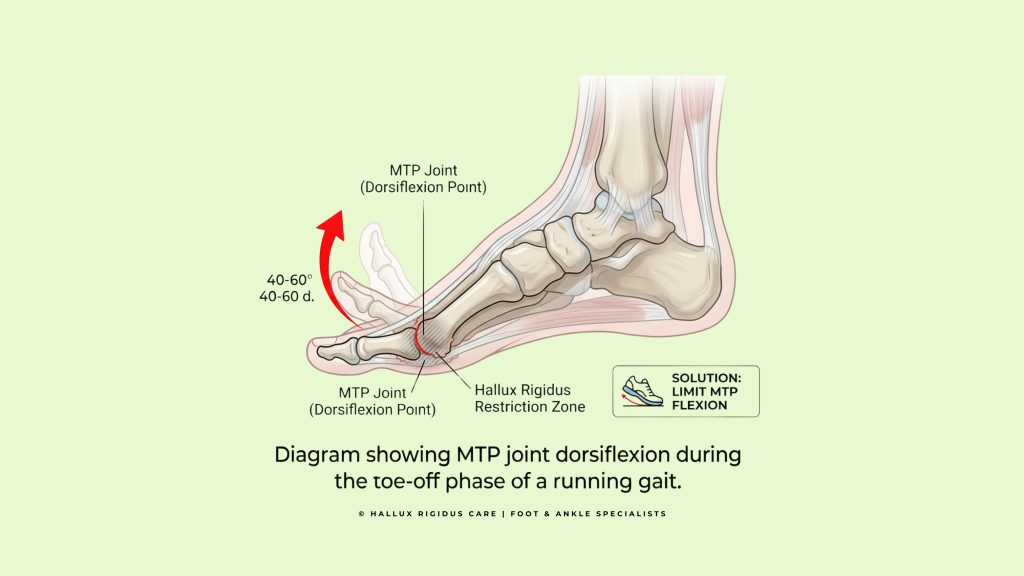
Running with hallux rigidus is possible for many patients, particularly in the early to moderate stages of the condition. The key challenge is that running requires significant dorsiflexion (upward bending) of the big toe during the toe-off phase of the gait cycle, exactly the movement that hallux rigidus restricts and makes painful.
Whether you can run and how much depends on your hallux rigidus stage. In Stage 1–2, most patients can run with appropriate footwear modifications. By Stage 3–4, running may be significantly restricted or contraindicated without surgical intervention. For a detailed breakdown of how disease progression affects function, see our hallux rigidus stages guide.
Why Running Aggravates Hallux Rigidus
During running, the MTP joint must dorsiflex 40–60 degrees to allow normal toe-off mechanics. In hallux rigidus, this range is progressively restricted by bone spurs and cartilage loss. The result: your body compensates by transferring load to the outer forefoot or by shortening your stride, which can cause secondary problems in the knees, hips, and lower back over time.
Running with hallux rigidus also generates significant impact forces through the MTP joint with each stride. This can accelerate joint degeneration if not properly managed.
Best Footwear for Running with Hallux Rigidus
Footwear is the single most important factor in making running with hallux rigidus sustainable. Look for these key features:
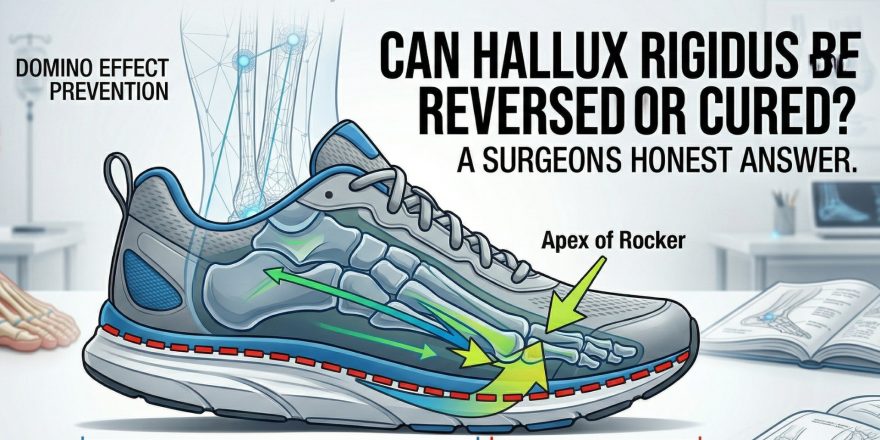
Rocker-Sole Geometry
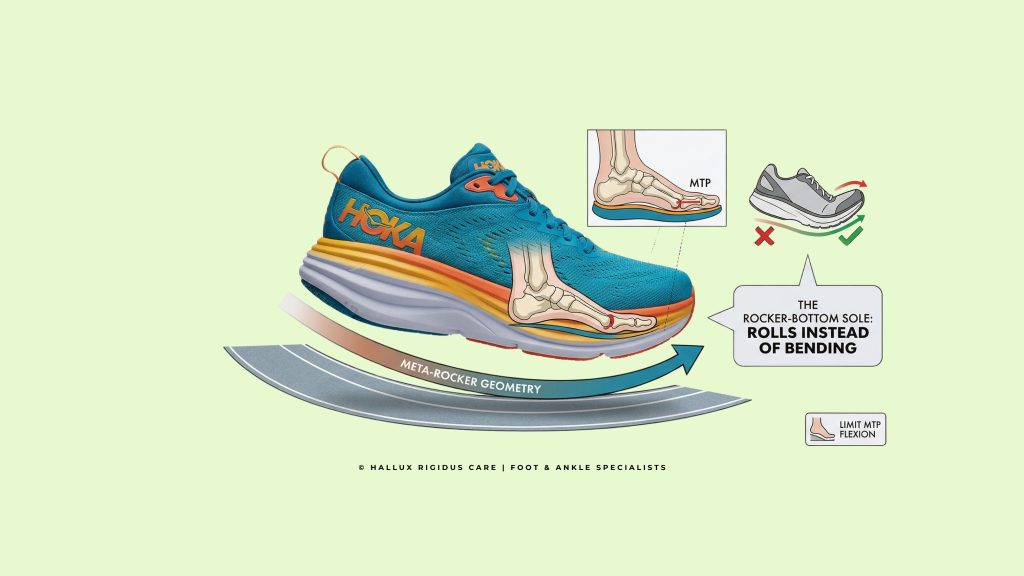
A rocker-bottom sole rolls the foot through toe-off without requiring the MTP joint to dorsiflex. This is the most important feature for running with hallux rigidus. HOKA shoes are well known for their aggressive rocker geometry. See our guide to the best HOKA shoes for hallux rigidus for specific model recommendations.
Stiff Forefoot
A stiff midsole at the forefoot limits the amount the toe bends during push-off. New Balance running shoes with their firmer midsoles in the 990 and 860 lines are popular among runners with hallux rigidus. See our best New Balance shoes for hallux rigidus guide for more options.
Wide Toe Box
Running with hallux rigidus is more comfortable when the shoe allows the toes to sit naturally without compression. A wide toe box prevents lateral pressure on an already-inflamed joint.
Morton’s Extension Insole
Adding a Morton’s extension orthotic inside your running shoe creates a rigid platform under the big toe that prevents forced dorsiflexion during toe-off. This is one of the most effective modifications for running with this condition.
Running Technique Adjustments
Beyond footwear, modifying your running mechanics can reduce MTP joint stress when jogging with big toe arthritis:
- Shorten your stride: A shorter stride reduces peak forefoot loading and decreases MTP joint dorsiflexion demand.
- Increase cadence: Running at a higher steps-per-minute rate naturally shortens stride and reduces impact forces.
- Land with a midfoot strike: Forefoot striking places high demand on the MTP joint. A midfoot strike distributes load more evenly.
- Run on softer surfaces: Grass, dirt trails, and rubber tracks generate lower impact forces than concrete or asphalt.
- Avoid uphill running: Inclines increase dorsiflexion demand at the big toe joint significantly.
Building a Running Plan with Hallux Rigidus
If you’re just starting with continuing your running routine or returning after a flare, follow a graduated approach:
- Week 1–2: Walk 20–30 minutes daily in stiff-soled shoes with orthotics. Monitor for post-activity pain.
- Week 3–4: Introduce 5-minute running intervals alternating with walking (e.g., run 5 min/walk 3 min × 4).
- Week 5–6: Increase running intervals to 10–15 minutes. Evaluate pain levels after each session.
- Ongoing: Increase distance by no more than 10% per week. Take 1–2 rest days between running sessions.
The “rule of thumb” for maintaining an active running lifestyle: if your pain is above 3 out of 10 during a run. Above 2 out of 10 the morning after. You’ve done too much. Scale back and allow the joint to recover.
Cross-Training Alternatives
When running with stiff toe arthritis isn’t possible due to a flare or advancing joint damage. These low-impact alternatives maintain cardiovascular fitness without stressing the MTP joint:
- Cycling or stationary bike: The pedaling motion requires minimal big toe dorsiflexion.
- Swimming: Completely non-weight bearing, with essentially no MTP joint stress.
- Elliptical trainer: Maintains running-like movement patterns with dramatically lower joint impact.
- Rowing: Upper and lower body workout that spares the toe joint.
Exercises to Support Running Despite This Condition
Strengthening and mobilizing the foot and lower leg help reduce the load placed on the MTP joint during running. Key exercises include calf raises, toe flexion against resistance, and intrinsic foot muscle strengthening. Our full program is available in our guide to hallux rigidus exercises.
Research published on PubMed supports the use of physical therapy and footwear modification as first-line conservative treatment for hallux rigidus. With good functional outcomes in early-stage cases.
When to Stop Running and See a Doctor
Stop running through joint degeneration and seek medical evaluation if you experience:
- Pain during running that exceeds 4–5 out of 10 despite footwear optimization
- Significant pain the morning after every run (even short, easy efforts)
- Increasing limp or compensatory gait changes
- New swelling or joint instability
If conservative measures are no longer sufficient, surgical options such as cheilectomy (bone spur removal) may restore enough range of motion to allow running again. Learn more in our guide to hallux rigidus surgery options.
Conclusion
Running with arthritic toe pain is achievable for many patients with the right combination of footwear. The key is to respect your joints’ limits, use appropriate support, and monitor symptoms carefully. If you find that running consistently causes unacceptable pain, cross-training alternatives can keep you fit. Meanwhile, your joint recovers, and a podiatrist can help evaluate whether surgical options might restore your ability to run more freely.
Running Shoe Features for Hallux Rigidus: What Matters Most
| Feature | What to Look For | What to Avoid | Why It Matters |
|---|---|---|---|
| Forefoot stiffness | Carbon plate, stiff nylon plate, or firm TPU | Flexible minimalist soles | Prevents painful dorsiflexion at push-off |
| Rocker geometry | Distinct Meta-Rocker or heel-to-toe curve | Flat profile shoes | Shifts pivot away from the first MTP joint |
| Toe box | Rounded, wide, and deep enough for toes | Pointed or tapered toe box | Prevents dorsal osteophyte compression |
| Stack height | 29mm or more at the forefoot | Zero-drop or minimal stack | Cushioning absorbs ground reaction force |
| Heel drop | 8 to 12mm | Zero or negative drop | Reduces forefoot load during stance |
| Toe spring | Positive toe spring (upward curve at front) | Flat or negative toe spring | Reduces dorsiflexion demand during late stance |
| Width availability | 2E or 4E wide options | Single narrow width only | Accommodates orthotics and forefoot splay |
Frequently Asked Questions
Will running make hallux rigidus worse?
Running can accelerate joint degeneration if done with poor footwear, high impact, or without managing the underlying condition. With the right footwear and technique modifications. Staying active with moderate big toe arthritis is unlikely to cause rapid progression in early-stage disease.
What is the best running shoe for hallux rigidus?
The best running shoes for hallux rigidus have a rocker sole and a stiff forefoot. HOKA models like the Bondi 9 and Clifton 9 are particularly well regarded for this purpose. See our detailed shoe guides for men and women with hallux rigidus for specific recommendations.
Can I run a marathon with hallux rigidus?
Some people do complete marathons with hallux rigidus, but it requires careful preparation, ideal footwear, and typically earlier-stage disease. As hallux rigidus advances, the demands of marathon training often exceed what the joint can tolerate. Consult a sports podiatrist to assess your specific situation.
Can I run with hallux rigidus without making it worse?
Running with hallux rigidus is possible in early to mid-stage disease when managed carefully. The key is to minimise dorsiflexion at the first MTP joint during the push-off phase. A carbon fibre plate insole with a Morton’s extension. Combined with a stiff rocker sole running shoe. Significantly reduces the dorsiflexion demand. Run on flat surfaces, keep sessions short initially, and monitor joint pain and swelling after each run. If you experience sustained pain increases after running, the activity load or footwear needs adjustment.
What type of running shoe is best for hallux rigidus?
Look for running shoes with a high stack height, maximum cushioning, and a rocker sole geometry. The carbon fibre plate found in many modern performance running shoes provides exactly the forefoot stiffness needed to protect the MTP joint. Brands known for rocker sole designs include HOKA, New Balance Fresh Foam, and similar maximalist platforms. Avoid flexible minimalist runners and barefoot shoes. Any shoe that can be bent easily in the forefoot. As these force full MTP dorsiflexion with each stride.
Should I stop running permanently if I have hallux rigidus?
Not necessarily. Many runners with Grade 1 and Grade 2 hallux rigidus continue running long term with appropriate footwear and load management. The decision depends on the severity of your condition. Your pain response to running. How effectively does your footwear setup reduce joint stress? Regular monitoring with a podiatrist or sports medicine physician helps you make informed decisions about continuing. Modifying. Pausing running as your condition changes over time.
Does running accelerate hallux rigidus progression?
High mileage running in inappropriate footwear can accelerate progression by repeatedly loading damaged articular cartilage through its most painful range. However, running in properly stiffened footwear that limits MTP dorsiflexion is significantly less damaging. The evidence suggests that the footwear and loading pattern matter more than running itself. Controlled, well-protected running is less harmful than unprotected casual walking in flexible footwear.
What running cadence adjustments help with hallux rigidus?
A higher cadence (shorter stride, more steps per minute) reduces the time spent in late stance and decreases peak MTP joint dorsiflexion per stride. Aim for 170 to 180 steps per minute rather than a long, powerful stride. This reduces the push-off demand on the big toe joint. Midfoot striking rather than heel striking, followed by a pronounced toe push off, also reduces MTP loading.
Can hallux rigidus surgery allow a return to running?
Cheilectomy, which removes the dorsal bone spur. Typically allows return to running within three to six months postoperatively for suitable candidates. Arthrodesis fuses the MTP joint and changes the biomechanics of push-off permanently. Return to recreational running is possible but requires significant gait adaptation and specifically designed rigid soled footwear.
Is cycling a good alternative to running for hallux rigidus?
Cycling is one of the best low-impact alternatives for people with hallux rigidus. This is because the pedalling motion requires minimal first MTP joint dorsiflexion. Road cycling in stiff-soled shoes. Particularly with a cleat positioned behind the MTP joint. Creates almost no stress at the arthritic joint. It maintains cardiovascular fitness while giving the foot a genuine rest from ground impact loading.